Crime & Law
Forum Brings Together Community Groups, Nonprofits and Police Officials
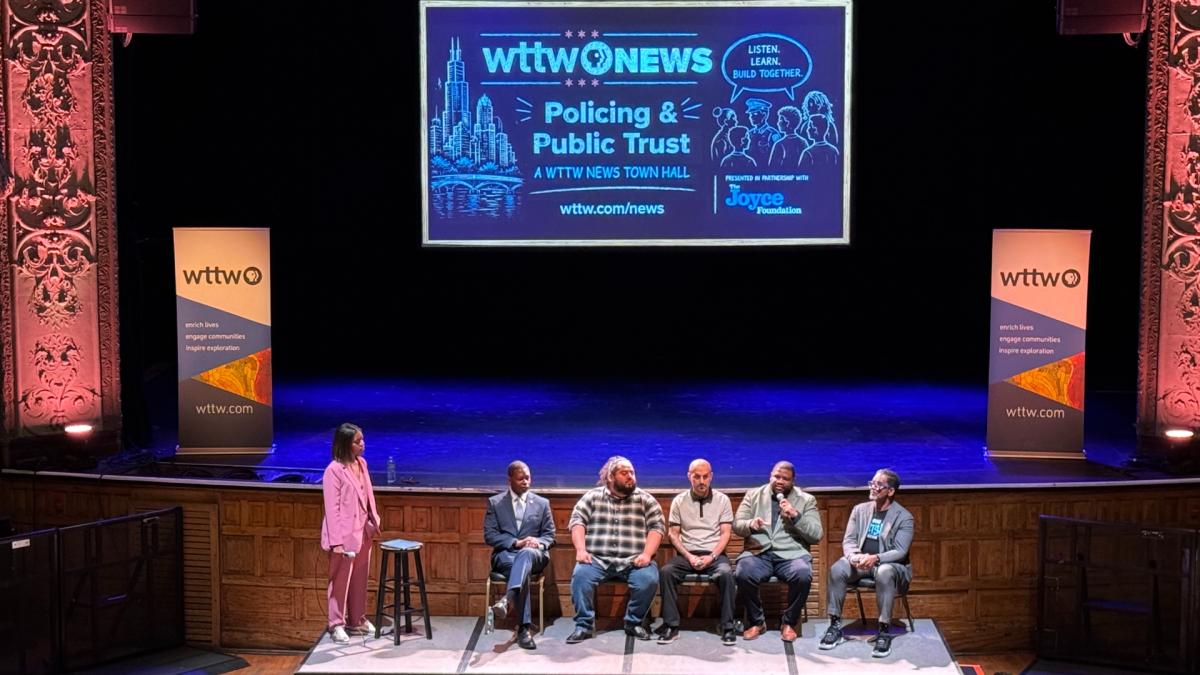 Brandis Friedman hosts a WTTW News forum on policing and public trust at Thalia Hall on May 26, 2026. (Jay Smith / WTTW News)
Nearly a hundred people gathered at Thalia Hall in Pilsen Tuesday night for a discussion presented by WTTW News on police-community relations.
Host Brandis Friedman and audience members put questions to a Chicago Police Department official, leaders of local anti-violence nonprofits and community-police organizations to try and assess the current state of community and police relationships.
It’s a relationship that is “improving,” said Glen Brooks, director of community policing for the Chicago Police Department. He said there’s been a “transformational difference” in conversations about policies.
“I promise you, back in 2000, 2003, if you said the community member wanted to talk about use of force, they would slam the door in your face,” Brooks said.
He said there’s now “a seat at the table” for community members.
But one area that audience members and other panelists emphasized a need for improvement is compliance with the consent decree, the court order that requires CPD to stop violating Black and Latino residents’ constitutional rights.
Leonardo Quintero, chair of the 12th District Council of the Community Commission for Public Safety and Accountability, said compliance with the decree is the “bare minimum.”
Brooks with CPD said it’s a “massive amount of work,” pointing to the 714 paragraphs of requirements the city must comply with.
“I want you to imagine not getting a Ph.D. in one subject matter, but now you have eight subject matters that you have to get a Ph.D in, and you got to do it in seven years, but you have to start from the eighth grade,” Brooks said.
One audience member from the Albany Park neighborhood wanted to hear more about progress that has been made with the decree.
“You mentioned that the city agreed to it, so if a student agrees to an assignment then complains that there’s too much work to do, rather than hearing … we’ll get it to you at some point,” the audience member said. “What I think a lot of people in the community want to hear is, in good faith, what progress have you made on those homework assignments?”
By the end of 2025, CPD fully complied with 25% of the consent decree.
Bradly Johnson, CEO of violence prevention group BUILD, said the consent decree won’t erase a history of a department that is tied to racism. BUILD has been able to create a relationship with his local police district, churches and community stakeholders to make decisions together.
“When people talk about trust and relationship with police, be realistic, it almost never really existed, so trust has to be created and built,” Johnson said. “If you don’t have a relationship, you can never feel safe in any way, shape or measure.”
WTTW News coverage of policing and police reform is supported by The Joyce Foundation.